
In short
- The black digits on the meter are kilolitres, the units your account is billed in. The red digits are litres, and they show a leak first.
- With every tap closed and nothing flushed, a meter that moves in 15 minutes means water is leaving the pipes somewhere on the property.
- The City puts one leaking toilet at 2,600 to 13,000 litres a month. At 2026/27 tariffs that adds roughly R243 to R1,215 a month for a stand-alone home already using 15 kl.
- A leak at the meter or in the pavement is reported to the City. A leak after the meter, on the property, is one for a plumber.
Knowing how to read your water meter in Bellville is worth ten minutes of any homeowner's time, because the meter is the only instrument on the property that sees every litre. A toilet trickling into the bowl overnight, a joint weeping under a slab or a garden line split by a root all show up on the dial long before they show up on a wall or a bill.
This guide covers where the meter is, how to read it, the City of Cape Town's 15-minute leak test, what a leak adds at the tariffs in force since 1 July 2026, and when a leak is one for a plumber in Bellville rather than the City.
Where Your Water Meter Is, And Which Valve Is Yours
The City says a property's water meter "usually sits in a small chamber under the pavement outside your property." Lift the lid and you will find the meter itself and, between it and the main in the street, the City's own isolating valve. Leave that one alone; the Water By-law forbids tampering with it.
Yours is a second valve on your side of the meter. The City calls it the main tap, or stopcock, and describes it as a stopcock or ball valve on the pipe between the meter and the house. Where the meter is on the pavement, the by-law puts it immediately inside the boundary. It is the one to close when a pipe bursts in the house.
Find it before you need it
If you cannot find or close your own stopcock and the City has to send a team to shut the supply for a repair, its 2026/27 tariff for that trip is R1,391.20 including VAT. Close it slowly, too: the City warns that slamming a stopcock shut causes water hammer, which over time loosens the brackets holding pipes and makes leaks more likely.
How To Read A Water Meter: Black Digits, Red Digits
The City's poster shows the two kinds of traditional meter used in Cape Town: one with a row of numbers and some round dials, and one with numbers only. Both record the same thing. On either, the City's rule is the same: black numbers are kilolitres and red numbers are litres. You are charged per kilolitre, so the black numbers are the reading that matters for the account.
- One kilolitre is 1,000 litres. A reading that moves from 0412 to 0427 on the black digits over a month means 15 kilolitres were used.
- The small units are your leak detector. On a dial meter, the City points to the dials for litres and fractions of a litre. On a numbers-only meter, look to the far right of the row, where the litres (second from the right) and the smallest unit (furthest right) turn. In 15 minutes a small leak moves these long before it moves the black digits.
- Photograph it. A dated photo of the dial is a better record than a note, and it is what you need if a bill looks wrong.
If the City's meter reader cannot get to the meter, because of a locked gate or anything else, and you have not sent in a reading, the bill is an estimate based on previous use. A new leak is not in that estimate, so it can hide behind estimated bills until an actual reading catches up. Submit your own reading on 0860 103 089 or through your municipal account on the City's e-Services portal; only the black numbers are needed. Account queries can also go to the City's Bellville Walk-in Centre in the Civic Centre on Voortrekker Road, open on weekdays from 08:00 to 16:00.
Some properties now have a City smart meter, which reports consumption daily, so no manual reading is needed. Its screen cannot be viewed, and the City asks owners not to remove the cover. Linked to the Smart Water tab on the City's app, it can trigger an "unusual usage" alert when it detects continuous flow over an extended period. The alert can take up to a day, though, and the City says the app "cannot identify the exact location of a leak on your property."
The 15-Minute Water Meter Leak Test
This is the City's own test, and it costs nothing:
- Stop all water use. Close every tap on the property and do not flush any toilet.
- Read the meter and write the reading down, or photograph it so the time is recorded too.
- Wait at least 15 minutes, making sure nobody opens a tap or flushes in the meantime.
- Read it again. If the number has gone up, there is a leak on the property.
The City adds a quicker tell: with everything closed, watch the last digit on the right of the counter. If it keeps moving, water is still flowing somewhere.
A moving meter tells you whether there is a leak, not where. To narrow it down, repeat the test with one branch closed at a time. Start with the small angle valves behind each toilet, because a toilet leaks into its own bowl where nobody sees it. Then the garden or irrigation line, then the cold supply to the geyser. When the meter stops moving, the last valve you closed is on the branch that is leaking.
Before you start
Switch off anything that draws water on its own: an irrigation timer, a fridge with an ice maker or water dispenser, a pool that tops itself up. Let any toilet finish refilling after its last flush. Otherwise the test measures them, not a leak.
Two moments are worth a test even when nothing seems wrong: a bill that jumps for no obvious reason, and the day after a City shutdown. Bellville has had several lately, including shut-offs for Selborne Slot, Oude Westhof, Kanonberg and Van Riebeeckshof in Welgemoed in August 2026 while a pressure reducing valve was fitted on their main, and for a large part of Belhar on 23 September. What to check when the water comes back after an outage covers the rest of that routine.
Three Toilet Checks For When The Water Meter Moves
Because toilets leak quietly into the bowl, the City's leak guide gives three checks for them specifically. None needs tools, and none involves taking anything apart:
- Listen. Water trickling into the bowl long after a flush has finished is water being lost.
- Press a piece of toilet paper against the inside back surface of the bowl. If it comes away wet, water is running down from the cistern.
- Add 15 drops of food colouring to the water in the cistern and leave the toilet unflushed. If the water in the bowl has changed colour after 15 minutes, the cistern is leaking into it.
A toilet that fails any of these has a fault in the cistern, which usually means a part rather than a new toilet. Until it is repaired, the City suggests using the small angle valve at the base of the toilet to keep it turned off between flushes, so it cannot run in the meantime.
What A Leak On The Water Meter Adds To Your Bill
The City estimates that one leaking toilet wastes between about 2,600 and 13,000 litres a month, depending on the flow, and a leaking tap between about 400 and 2,600 litres.
Water is charged in rising steps. For a stand-alone home on the water-wise tariffs in force since 1 July 2026, the first 6 kilolitres cost R25.85 each, the next 4.5 cost R36.76, everything from 10.5 to 35 kilolitres costs R61.37, and every kilolitre above 35 costs R147.77, all including VAT. Leaked water lands on top of what the household already uses, so it is charged at the highest step the account reaches that month, not at an average.
Sanitation follows it. For stand-alone homes the City charges sanitation on 70% of metered water, capped at 35 kilolitres of sewerage a month, so each leaked kilolitre adds to that line as well.
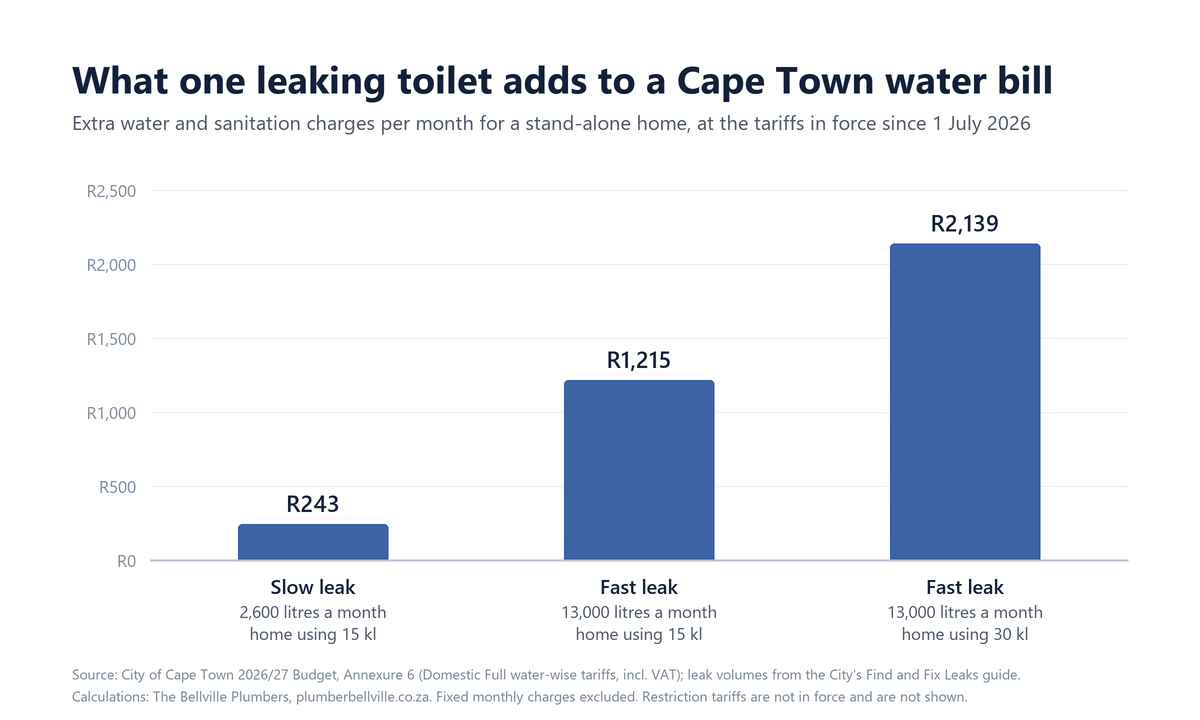
| Leak (City estimate) | Water lost a month | Extra a month, home using 15 kl |
|---|---|---|
| Leaking tap | 400 to 2,600 litres | R37 to R243 |
| Leaking toilet | 2,600 to 13,000 litres | R243 to R1,215 |
A household that already uses more pays more for the same leak. In a home using 30 kilolitres a month, a toilet losing 13,000 litres pushes the account past 35 kilolitres, into the R147.77 step, and adds about R2,139 a month.
These figures are for a stand-alone home on its own meter, which describes most of Boston, where 89.2% of the 1,366 homes are freehold. Sectional-title complexes and gated villages, common in places like Oak Glen, where fewer than half of the 2,338 homes are freehold, are billed on the City's cluster tariff. The step rates match, but the steps and sanitation are applied differently, so the totals will differ.
No water restrictions are in force. EWN reported on 17 September 2026 that the City plans to decide at the end of October whether to declare them. If it does, the Water By-law allows special tariffs during restrictions, and the 2026/27 budget already sets out a higher Level 2 schedule. Only if that schedule were applied would the fast toilet leak in a 15 kl home cost about R1,635 a month instead of R1,215. What water restrictions would change at home goes into the detail.
A Leak At The Water Meter? Who To Call
Where the leak is decides who to call. Water bubbling out of the pavement, around the meter box or from the meter itself, so before or at the meter, is reported to the City. A meter that keeps moving with everything on the property closed points to a leak after the meter, inside the boundary, and that is one for a plumber.
Report a leak in the street, the pavement or at the meter to the City by WhatsApp on 060 018 1505, by phone on 0860 103 089 (option 2 for water faults), or by SMS to 31373 with the location and a contact number in up to 160 characters. Keep the reference number it gives you.
When The Water Meter Keeps Moving And You Cannot Find Why
Some leaks never show. A supply pipe under a concrete floor, a joint inside a wall or a garden line under paving can lose water for months with nothing to see. The City's own guide says most underground leaks are not a DIY project, and that a leak detection specialist with proper equipment may be needed to find them. Once the meter test and the branch-by-branch closing have narrowed it to a section, leak detection in Bellville uses acoustic listening, thermal imaging and tracer gas to pin it down, so the floor or wall is opened once and in the right place.
For the leaks you can see, a running cistern or a dripping tap, tap and toilet repairs are usually one visit and one part. Either way, read the meter again afterwards. It is the only proof that the loss has actually stopped.
Questions Bellville Homeowners Ask
How many litres is one unit on a Cape Town water account?
One kilolitre, which is 1,000 litres. Water and sanitation are both billed per kilolitre, so a leak that wastes 2,600 litres a month adds 2.6 units to the water line. For a stand-alone home, sanitation is then charged on 70% of that.
Why does my water meter keep running when no taps are open?
Either something is drawing water on its own, or there is a leak. Check for a cistern still refilling after a flush, an irrigation timer, a fridge with a water connection or a pool that tops itself up. Switch those off and run the 15-minute test again. If the meter still moves, water is leaving the pipes somewhere on the property.
Can a water meter reading be wrong?
A bill can be based on an estimate rather than a reading: when the City cannot get to the meter and nobody has submitted a reading, it estimates from previous use. Compare the reading on the bill with a dated photo of the dial, and send in the actual figure on 0860 103 089 or through e-Services. If you think the meter itself is faulty, report it to the City. The Water By-law lets you apply to have it tested, for a charge that is refunded if the meter is found to be outside the permitted tolerance.
Sources
- City of Cape Town: Water meter readings (checked 12 October 2026)
- City of Cape Town: How to read your water meter (poster)
- City of Cape Town: Find and Fix Leaks guide
- City of Cape Town: DIY Guide to Finding and Fixing Water Leaks (November 2022)
- City of Cape Town: How the City manages leaks and burst pipes, guide and FAQs (updated 17 October 2018)
- City of Cape Town: Smart Water on the City of Cape Town app, FAQs (version 11 September 2026)
- City of Cape Town 2026/27 Budget, Annexure 4: water-wise (no restriction) tariffs from 1 July 2026 (June 2026)
- City of Cape Town 2026/27 Budget, Annexure 6: water tariffs, Level 1 (June 2026)
- City of Cape Town 2026/27 Budget, Annexure 6: sanitation tariffs, Level 1 (June 2026)
- City of Cape Town 2026/27 Budget, Annexure 6: water tariffs, Level 2 (June 2026)
- City of Cape Town 2026/27 Budget, Annexure 6: sanitation tariffs, Level 2 (June 2026)
- City of Cape Town 2026/27 Budget, Annexure 6: tariffs, fees and charges book (shut-off visit, item 9.2 of the water miscellaneous tariffs) (June 2026)
- City of Cape Town Water By-law, 2010: sections 23, 32 and 36
- City of Cape Town: Bellville Walk-in Centre
- City of Cape Town: Planned water supply maintenance for 18 to 23 August (16 August 2026)
- City of Cape Town: Planned water supply maintenance for 21 to 25 September 2026 (20 September 2026)
- EWN: City of Cape Town to make a decision in October over possible water restrictions (17 September 2026)
- Bizcommunity: Cape Town's Bellville and Parow show substantial house price growth (Lightstone figures for Boston and Oak Glen) (4 March 2024)
Written by The Bellville Plumbers, a plumber in Bellville based at 132b Durban Rd, Bellville, working across Bellville, Parow, Goodwood, Brackenfell and Kraaifontein. This is general guidance; a plumber on site can tell you what applies to your property.